The gap between "compostable" and "composted"
Two words, one suffix, and an ocean of difference. A material can be compostable in a laboratory and never compost in real life. The label tells you the chemistry is plausible. It says nothing about whether the system around the chemistry actually works.
This is the quiet failure of most bio-compostable plastic on the market today. It's manufactured to a real standard. It carries a real certificate. And then it ends up in a regular waste stream, gets incinerated alongside conventional plastic, and the only thing that composts is the company's marketing budget.
"Soil to soil" is our shorthand for the opposite commitment: that every product we put into circulation has a path back to the ground, designed and operated by us, not left to the optimism of someone else's recycling infrastructure.
Two kinds of circularity
It helps to draw a line between two very different ideas that share the word "circular".
Technical circularity is what most of the recycling world is built on. Atoms are kept in motion by industrial machinery: melt, reshape, repeat. PET bottle becomes another PET bottle. Aluminium becomes another aluminium can. The loop is closed by sorting plants, smelters, and pelletisers. It's a remarkable system. It's also energy-intensive, and it tends to leak, every cycle loses material to wear, contamination, and downcycling.
Biological circularity works on different physics. The atoms don't get pushed around by machines. They get eaten. Microbes break the material down into water, CO₂, and biomass, the same building blocks every living thing has been using for four billion years. The loop closes itself if you give it the right conditions, because biology has been doing this for longer than capitalism has had a name for it.
The key insight is that some materials belong in one loop and some belong in the other. Steel, aluminium, glass, and PET are technical-cycle materials. Food, garden waste, paper, and plant-based polymers are biological-cycle materials. Trying to push a biological-cycle material through a technical-cycle infrastructure is what creates the "compostable plastic in landfill" problem we set out to solve.
Closed-loop systems are crucial for bio-compostable plastics. When they end up in conventional waste, their ability to degrade is limited. Our work is about making sure the whole chain, from microbe to material to compost, actually closes.Dr. Shu Yuan Yang, Director of Research, GRØNBLÅ
Peat replacement is the keystone
Most arguments for bio-compostable plastic stop at "it composts." Ours doesn't. Composting is the middle of the story. The end of the story is what the compost does.
Right now, an enormous fraction of the world's potting soil and growing media is made from peat, a substance we extract from bogs that took ten thousand years to form. Peat extraction releases stored carbon (a lot of it), drains wetlands, and damages some of the most carbon-rich ecosystems on the planet. The horticulture industry knows this. Regulators know it. The replacement question, what do we use instead of peat?, is one of the highest-leverage carbon decisions in agriculture.
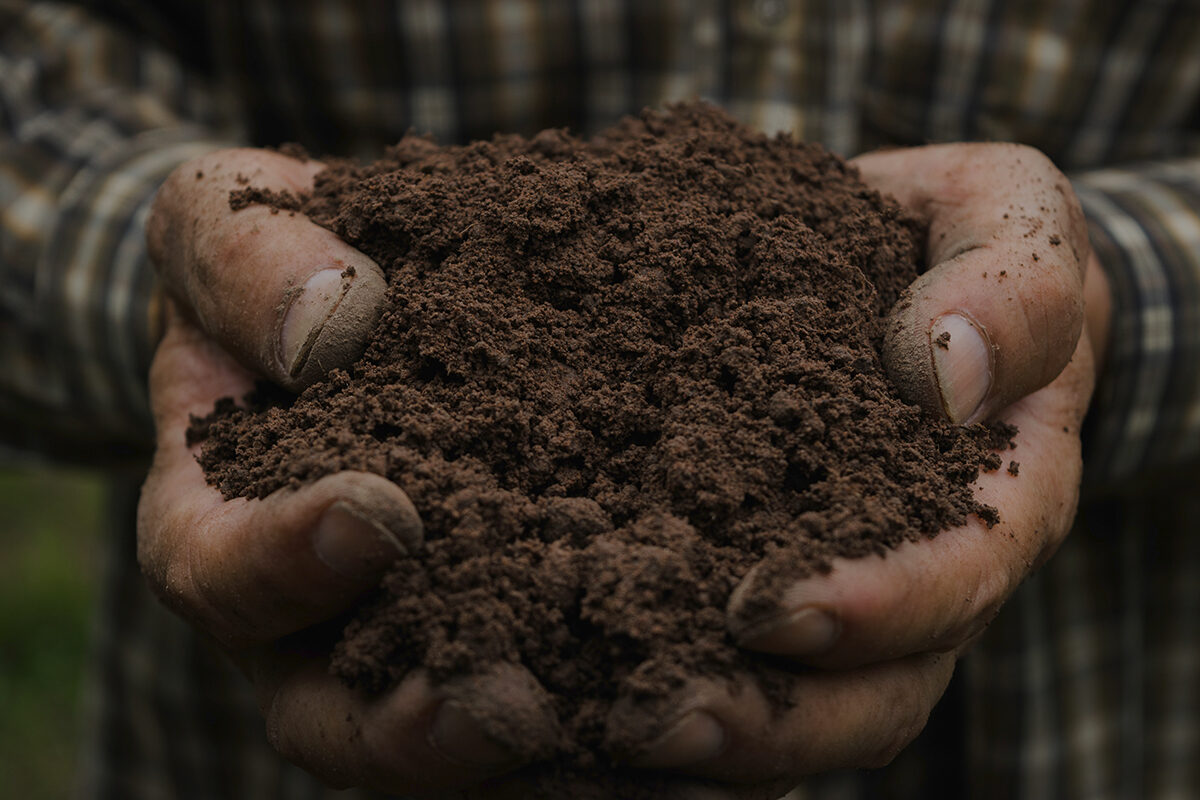
Mature, certified compost is one of the best peat replacements available. It improves soil structure, holds water, feeds microbial life, and stores carbon back where it belongs. The bottleneck has always been supply: there isn't enough quality compost going into horticulture and agriculture, partly because the input streams are contaminated with non-compostable plastic.
This is where our system completes the keystone. Every event we process is a small contribution to a peat-replacement supply chain. The cup that held a beer at a stadium becomes part of the soil that grows next year's tomatoes. That's not a metaphor we're stretching, it's the literal physics of where the carbon goes.
Regenerative, not just sustainable
"Sustainable" is a word that asks not to make things worse. "Regenerative" is a word that asks to make things actively better than we found them. The difference matters because most compostable-plastic projects aim at the first bar, they try to be neutral, and biological circularity, properly run, can clear the second.
A regenerative system isn't only about not damaging ecosystems. It's about contributing to them. Compost-rich soil is more biologically active than degraded soil. Peat-replaced bogs can be rewetted and start sequestering carbon again. Microbes trained on PLA become part of a research library that grows over time. Each loop we close is also a small experiment in whether the next loop can close faster, with more value, in more places.
This is why we keep insisting that the closed loop isn't a feature of our products, it's the company. Most of what we do day-to-day is not about plastic. It's about building the operational and biological infrastructure that lets plant material go back to plant material as cleanly as possible.
What "soil to soil" rules out
Naming the spine clearly is also a way of being clear about what we won't do. A few practical examples:
- We don't ship bio-compostable plastic into systems that won't compost it. If a venue can't or won't run the recovery side, we'd rather they kept their conventional plastic until they're ready. A "compostable" cup that ends up incinerated is just expensive plastic.
- We don't use food crops as feedstock. Sugarcane bagasse, corn stover, cassava residue, the parts not used for food. Food displacement isn't progress.
- We don't sell "compostable" claims without the system to back them up. The product is half the loop. The compost machine and the off-take partner are the other half. We sell both halves or neither.
- We don't optimise for the certificate. Certifications are necessary and we hold them. But chasing certificate-by-certificate is how you end up with technically-compostable products in non-composting waste streams. We optimise for the actual end state of our material, which is soil.
The longer view
If you take the soil-to-soil principle seriously, it leads to questions that go beyond bio-plastic. Which other linear products could be redesigned to belong in the biological cycle? Which crop residues could become feedstocks for new materials? Which industrial composting infrastructures could become regional carbon-sequestration assets? Which municipalities have the regulatory imagination to treat compost as essential infrastructure rather than waste-management overhead?
We don't have answers to all of these yet. We do have an operating loop, a research library, and a partner network, and a lot of conviction that biological circularity is going to be the part of the climate response that finally lives up to its name. The rest is work.