The signature story

The closed loop, in eleven steps.

Most "compostable" plastic never reaches a composting facility. Ours does, because we run every step from crop residue through to finished, peat-replacement compost, including the industrial composting on-site at partner venues. When the system operates end-to-end, the material avoids landfill and incineration and leaves no microplastic residue in the finished compost.

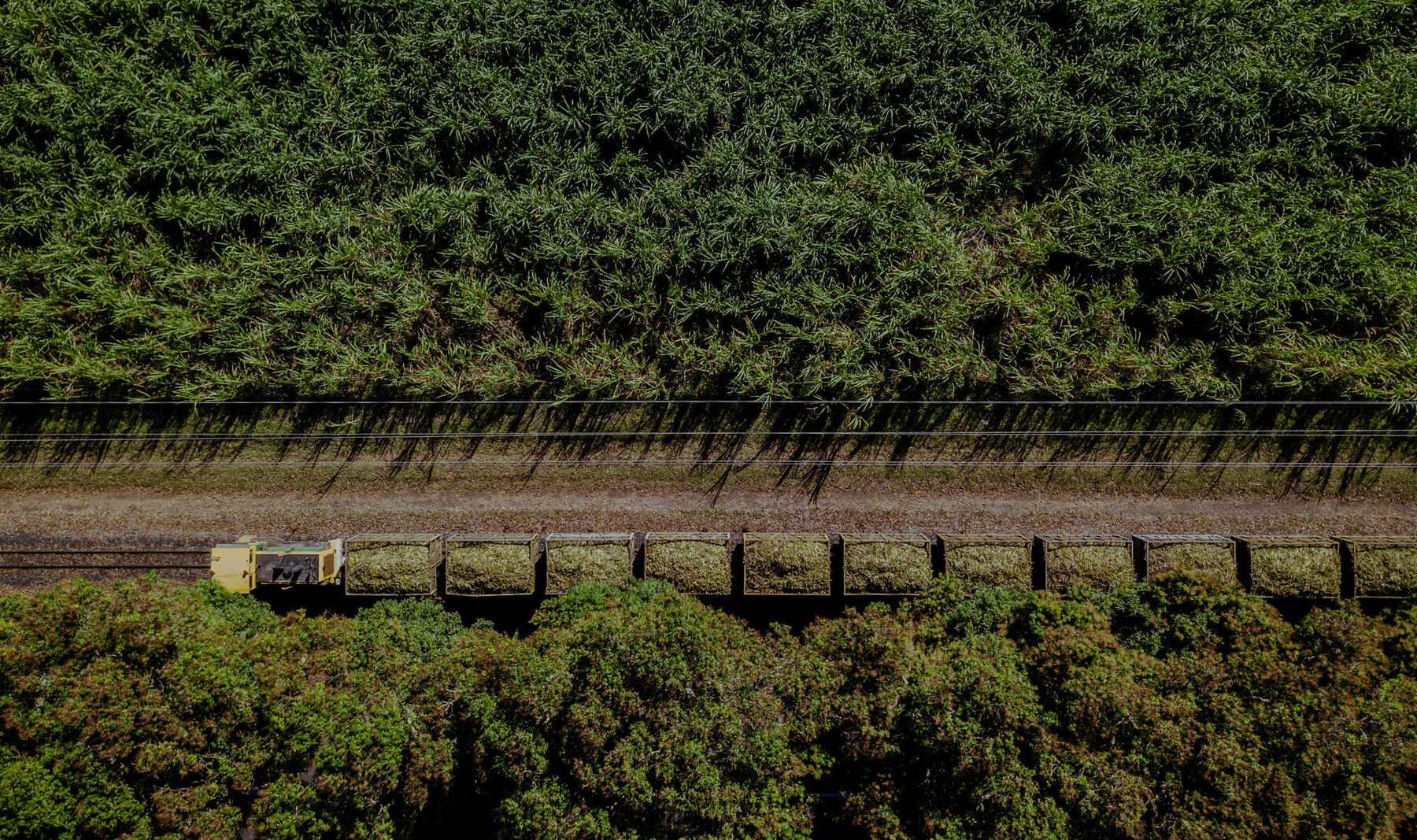
Aerial view of a sugarcane field with a harvester
  1. 1. Crop by-products, not food, not fossil oil

    Our PLA starts as the residue of agricultural crops: sugarcane bagasse, corn, and cassava. These are the parts that don't end up on a plate. Renewable, plant-based feedstock, not petroleum, not food displacement.

    Our European-distributed SKUs are predominantly sugarcane-derived, with corn-derived PLA where supply geography or formulation requires it. Exact ratios per SKU are documented in the material datasheets, shared under NDA.

  2. 2. Sugars released and fermented into lactic acid

    The plant material is processed to release sugars, which are then fed to micro-organisms in a controlled fermentation. The microbes convert the sugars into lactic acid, the same family of acid that makes yoghurt yoghurt.

  3. 3. Lactide rings polymerised into PLA

    Lactic acid is purified, dehydrated into lactide rings, and then ring-opened into long PLA polymer chains. The result is a clean, food-safe biopolymer that behaves remarkably like conventional plastic on the production line.

  4. 4. Products manufactured at our factory

    GRØNBLÅ designs and distributes products built from this PLA, manufactured at our factory in Taichung, Taiwan. Cups, lids, trays, sheets, bags, cutlery, cycling water bottles, engineered for performance, certified for compostability.

    See the product catalogue to

  5. 5. Used, and intended to be used once

    The point of single-use plastic isn't single use. It's convenience. We don't fight that, we replace it with a material that finishes the loop instead of starting a 400-year stay in the environment.

    We're all about revolutionising packaging and accessories with compostable plastics.Jayu Yang, Co-founder & CEO
  6. 6. One green bin, guests don't have to sort

    Here's where most "compostable" stories fall apart. Guests can't tell the difference between PLA and lookalike plastic. So at our venues, food waste and GRØNBLÅ products go into the same bin. That single change is what makes recovery actually work at scale.

    The instruction to the guest is one sentence: "It came from the GRØNBLÅ counter, it goes in the green bin."

  7. 7. Pre-treatment in a closed indoor line

    The collected mix is transported in closed containers to the on-site treatment area. A dedicated grinder reduces the material to a uniform particle size before it enters the compost machine. Closed handling means no diffuse dust or odour at pre-treatment, and no contamination with downstream waste streams.

  8. 8. In-vessel composting in our compost machines

    The pre-treated material is loaded into our in-vessel compost machines, which we dose with our PLA-trained microbe cultures (more on those below). These are not the typical air-cooled composters: an oil jacket actively regulates temperature inside the tank, holding the optimal range for aerobic microbial decomposition. Precise temperature plus a microbe library trained on PLA is what shortens the batch.

    Process typeAerobic microbial decomposition (qualifies as "kompostering" under K214)
    Temperature controlActive oil jacket (not air-based)
    Batch operation3 days continuous after each event
    Carbon filter240 m³/h, replaced monthly
    OutputPre-compost (not finished compost)
  9. 9. Automatic hygienisation cycle every 5 days

    The compost machines run an automatic hygienisation cycle every five days. The oil jacket elevates the temperature high enough to eliminate unwanted bacteria and pathogens. The cycle is synchronised with the off-take schedule so compost machines are sanitised and ready to empty at every collection.

  10. 10. Pre-compost off-take by Jysk Muld / RGS Nordic

    Every five days, our partner Jysk Muld A/S, part of RGS Nordic, picks up the pre-compost. They handle final maturation under industry-standard conditions, completing the biological process started in our compost machines.

  11. 11. Peat replacement, into soil

    Finished compost replaces peat in horticulture and agriculture. Peat extraction releases stored carbon and damages bog ecosystems, replacing it with mature, certified compost is one of the highest-leverage moves the soils industry can make. The loop closes.

    Plastics and packaging no longer end up as macro- or microplastic. They end up as fertile soil.

The science behind faster decomposition

Microbe cultures, trained on PLA.

Standard industrial composting of PLA takes around three months at 50–60 °C. Ours takes meaningfully less, because we don't rely on whatever microbes happen to be in the compost. We feed our compost machines cultures specifically trained to digest PLA.

Why standard composts struggle with PLA

PLA is a recent addition to the natural world. Most environmental microbes weren't selected to break it down, they have no particular advantage in feeding on it. Drop PLA into an off-the-shelf industrial compost and you'll see slow, uneven degradation, with bits of cup or cutlery still recognisable at the end of the cycle.

Our PLA-trained microbe library

Our research lab, led by Dr. Shu Yuan Yang at Chang Gung University in Taiwan, has spent years training microbe cultures on PLA. By repeatedly feeding compost mixes with PLA over time, we've enriched the populations of microbes that handle it best. From those enriched mixes we've isolated bacterial strains that satisfy two non-trivial criteria: they degrade PLA, and they can be cultivated reliably outside the compost. Together they form our microbe library, strains we can dose into a compost machine, not hope are there by accident.

The trained cultures act as an active inoculant in our compost machines. Each generation is sampled and re-tested against PLA, and newer, faster strains gradually replace older ones. The library improves with every cycle.

What this means in practice

Closed-loop systems are crucial for bio-compostable plastics. When they end up in conventional waste, their ability to degrade is limited. Our work is about making sure the whole chain, from microbe to material to compost, actually closes.Dr. Shu Yuan Yang, Director of Research, GRØNBLÅ

What makes ours different

Four things that break the typical "compostable plastic" story.

🔁

We own every step

From sourcing the right factory-grade PLA to the in-vessel compost machine on-site, to the Jysk Muld off-take. No "and then we hope it goes to the right facility" gap.

🪣

Single-bin design

Our products are designed so guests don't have to sort. Food waste and PLA go in the same green bin. Behaviour change is hard, we don't ask for any.

🦠

PLA-trained microbes

Our compost machines are dosed with microbe cultures specifically trained on PLA, developed in our research lab and improving with every batch. Faster decomposition, by design.

🌾

Output has a buyer

Finished compost replaces peat. There is real demand from horticulture and agriculture, so the loop has economics, not just an environmental story.

At a glance

The whole loop on one page.

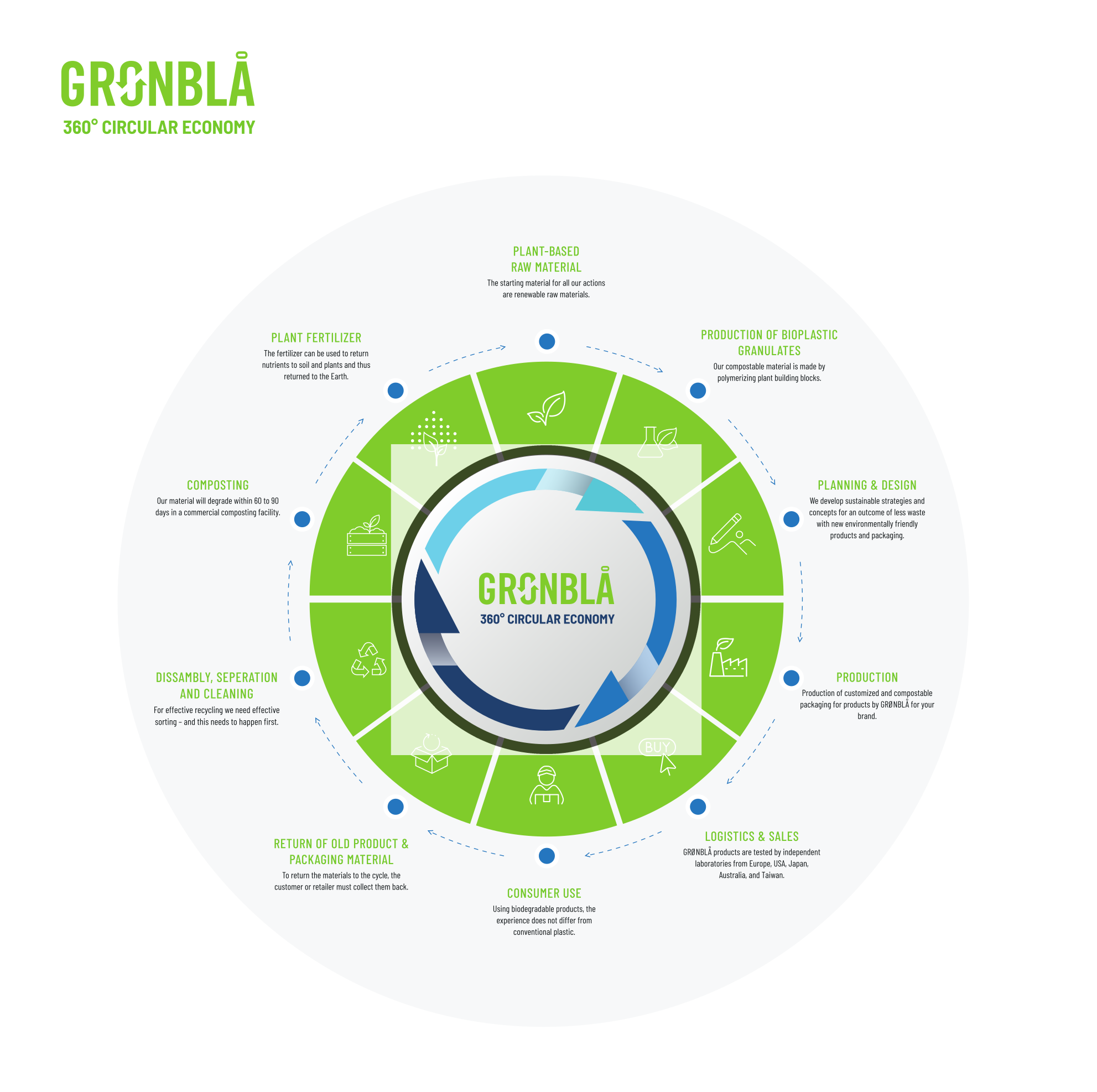
GRØNBLÅ closed-loop diagram: from crop by-products through PLA products and in-vessel composting to peat-replacement compost

Click to enlarge ⤢

Run the loop at your venue.

From a single-event pilot to a full-season deployment, we'll help you plan, install, and operate the system end-to-end.