Blog · Case study
Five days in Ballerup.
Before Parken, there was the 2024 Tissot UCI Track Cycling World Championships. Five days. About 12,500 spectators per session. One green bin. What worked, and what we changed.

Before Parken, there was the 2024 Tissot UCI Track Cycling World Championships. Five days. About 12,500 spectators per session. One green bin. What worked, and what we changed.
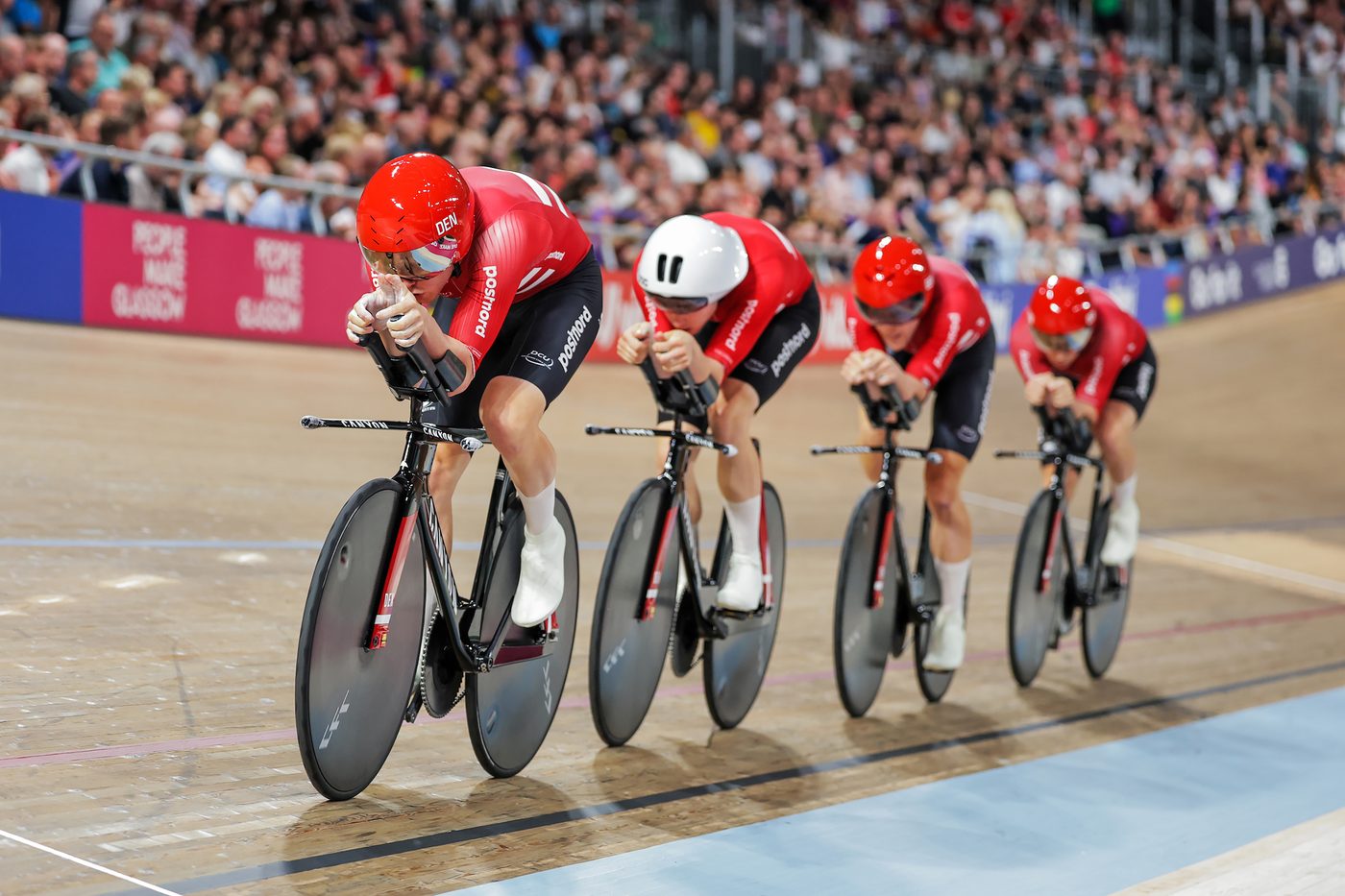
Before Parken, we ran our first arena-scale single-bin compostable system at the 2024 Tissot UCI Track Cycling World Championships in Ballerup. Five days of competition. About 12,500 spectators per session. One green bin for everything served at our counters. The whole thing was, by design, a stress test.
Some of what we learned at Ballerup is what later made the Parken deployment work. So here it is in full, including the parts that didn't go to plan.
The Tissot UCI Track Cycling Worlds happens in the indoor velodrome at Ballerup Super Arena. Five days, 14 sessions, capacity around 12,500 per session. Catering operates at concourse stands around the inner ring, with peak service in the windows between races. The model is different from a football match: more compact, more intense, more sessions per day.
Our setup: bio-compostable cups, lids, trays, plates, cutlery, serviettes at every GRØNBLÅ counter. Single green bins distributed throughout the concourse. On-site pre-treatment in a closed indoor space behind the catering operation. Pre-compost transferred daily to our processing partner (this was before the Jysk Muld off-take agreement was contracted; we used a transitional setup for the event).
Across five days and 14 sessions, the single-bin model held. Roughly 70 % of front-of-house waste was captured in the GRØNBLÅ stream. The other 30 % was a mix of items not sold from our counters (sponsor giveaways, items spectators brought in, soft-plastic packaging) that went into general waste. The proportion was higher than we expected for a first run.
The blockquote we keep using on the site is from a partner at the event:
All waste can go into the same bin and be composted, a game-changer for large sporting events.
It's the kind of testimonial that sounds promotional in isolation. After five days of seeing it work, we had the same reaction. The single-bin model isn't a slogan: at the operating level it removes an entire layer of complexity from the venue.
Three things we changed for Parken, all of them learned at Ballerup.
1. Off-take logistics. Daily transfer to an off-site processor was fragile. A single delayed pickup creates a holding-capacity problem at the venue. For Parken we moved to a five-day on-site cycle with a single scheduled pickup, which reduced the dependency on day-to-day logistics.
2. Pre-treatment placement. We had the indoor grinder too far from the bin collection point. The walk was long enough to be operationally painful for the cleaning crew. For Parken we co-located the grinder with the bin collection, cutting the workflow.
3. The 30 % we didn't capture. Most of that was sponsor giveaways using conventional packaging. For Parken-class venues we now have a conversation with the procurement team upstream about sponsor and partner packaging before the contract goes out. The single-bin model only works if everything in scope is in the same stream.
It was the first time we ran the full closed-loop concept at arena scale, and it gave us the confidence to walk into the Parken conversation with operational evidence, not just slides. The 30 % per-guest reduction at Parken in 2025 (now published in their annual report) is the bigger headline. But the system that made it possible was prototyped at Ballerup. The honest credit goes there.
If you operate a venue and any of this is on your roadmap, we'd like to hear what you're up against. Two business days to a response.